Publications internationales

2025
Zaimi, Rania; Safi Eljil, Khouloud; Hafidi, Mohamed; Lamia, Mahnane; Nait-Abdesselam, Farid. (2025), An enhanced mechanism for malicious URL detection using deep learning and DistilBERT-based feature extraction: An enhanced mechanism for malicious URL detection. Journal of Supercomputing : springer, https://openurl.ebsco.com/EPDB%3Agcd%3A11%3A37486763/detailv2?sid=ebsco%3Aplink%3Ascholar&id=ebsco%3Agcd%3A182595570&crl=c&link_origin=scholar.google.com

Résumé: In today’s digital age, the rapid increase in online activities has heightened web users’ privacy risks, making them more susceptible to various cyber-attacks. Among these, phishing is one of the most widespread threats in cybersecurity. Phishing employs deceitful tactics to lure individuals and organizations into visiting malicious URLs and disclosing sensitive information, such as passwords, credit card details, and personal data. These attacks are carefully crafted to mislead users into believing they are interacting with legitimate websites or online services, to steal account information for malicious purposes. To address the limitations of traditional phishing detection methods—such as their inability to detect zero-day attacks, high rates of false positives and negatives, and the need for frequent updates to list-based approaches (e.g., blacklists and whitelists)—this paper presents an advanced approach for identifying malicious URLs by integrating transformer learning and deep learning techniques. Specifically, Distilled Bidirectional Encoder Representations from Transformers (DistilBERT) extracts features from URLs and captures relevant textual information. A hybrid deep learning model combining convolutional neural network (CNN) and long short-term memory (LSTM) layers is then applied to classify the dataset into malicious and legitimate URLs. The novelty of this method lies in combining DistilBERT with a hybrid deep learning model (CNN-LSTM) to detect malicious URLs. The proposed approach was evaluated on two large public datasets to test its effectiveness under various conditions. Experimental results demonstrate that it performs exceptionally well, achieving the highest accuracy of 98.19%, and outperforming some comparable methods in the literature on similar datasets. This proves that the integration of DistilBERT and the hybrid CNN-LSTM model is successful in detecting malicious URLs. DistilBERT optimizes the feature extraction process, while the CNN-LSTM model leverages the strengths of both models and mitigates the limitations of each, resulting in a more comprehensive approach to classification.

2024
Rania Zaimi, Mohamed Hafidi, Mahnane Lamia. (2024), A deep learning mechanism to detect phishing URLs using the permutation importance method and SMOTE-Tomek link. The Journal of Supercomputing : Springer Nature BV, https://www.proquest.com/openview/155ec98e16be1a4321dd916dcb1cddf4/1?pq-origsite=gscholar&cbl=2043774

Résumé: In contemporary times, the proliferation of phishing attacks presents a substantial and growing challenge to cybersecurity. This fraudulent tactic is designed to deceive unsuspecting individuals, enticing them to access malicious websites and disclose sensitive personal information such as usernames, passwords, and financial details. As a result, malevolent actors exploit this data for illicit purposes. As the sophistication and maliciousness of phishing continue to evolve, researchers are earnestly developing multiple anti-phishing solutions in the literature. Among these solutions, those based on machine learning and deep learning models have gained substantial attention in recent years. This study proposes an intelligent mechanism to detect phishing URLs. The proposed system is based on the permutation importance method to select the most relevant URL features and the SMOTE-Tomek link method to solve …

Noura Zeroual, Mahnane Lamia, Mohamed Hafidi. (2024), A pedagogical orientation system based on blockchain technology and machine learning. Education and Information Technologies : Springer US, https://link.springer.com/article/10.1007/s10639-023-11941-z

Résumé: Traditional education systems do not provide students with much freedom to choose the right training of study that suits them, which leads on long-term to the negative effects not only on social, economic and mental’ well-being of student, but also will have a negative effect on the quality of the work produced by this student in the future. In addition, skills and talents in a specific area refer to general skills and working life practices. This paper presents a pedagogical orientation system based on blockchain technology and machine learning that accurately predicts the future specialized training and profession in which the common core student will have more opportunity to succeed. Python programming language has been used to implement the suggested pedagogical orienting mechanism in two key steps. (1) In the profiles matching step we have used the incidence matrix to correlate the professional and training profiles. (2) The student ranking issue was resolved at the ranking profiles step using the learning to rank methodology. The data used to feed the various machine learning algorithms in our system are stored on the blockchain, representing the academic results of 320 students at the end of the common core training in the computer science department of 20th august 1955 university in Skikda, Algeria, which served as a database for subsequent experiments and served to confirm the system's feasibility and credibility. The proposed system has demonstrated its effectiveness by accurately predicting the future specialized training compatible with the student's scientific capabilities, allowing him to succeed and excel. Also, it has contributed to reducing the possibility of falsifying results and certificates while enhancing security and transparency through blockchain protocols. Finally, this system encourages all participants to trust the automatic orientation process, which makes it possible to improve the issues experienced in the fields of education by enhancing interactions between the student, the university, and the employing industries during the educational orientation process.

2023
Ouissem Benmesbah, Mahnane Lamia, Mohamed Hafidi. (2023), An improved constrained learning path adaptation problem based on genetic algorithm. Interactive Learning Environments : Routledge, https://www.tandfonline.com/doi/abs/10.1080/10494820.2021.1937659
Noura Zeroual, Mahnane Lamia, Mohamed Hafidi. (2023), A pedagogical orientation system based on blockchain technology and machine learning. Education and Information Technologies : Springer US, https://link.springer.com/article/10.1007/s10639-023-11941-z
Rania Zaimi, Mohamed Hafidi, Mahnane Lamia. (2023), A deep learning approach to detect phishing websites using CNN for privacy protection. Intelligent Decision Technologies (IDT)https://content.iospress.com/articles/intelligent-decision-technologies/idt220307
2022
Mohamed Hafidi, Mahnane Lamia. (2022), A hybrid model to detect phishing-websites. International Journal of Internet Technology and Secured Transactionshttps://www.inderscienceonline.com/doi/abs/10.1504/IJITST.2022.126472
2021
Ouissem Benmesbah, Mahnane Lamia, Mohamed Hafidi. (2021), An enhanced genetic algorithm for solving learning path adaptation problem. Education and Information Technologies : Springer US, https://link.springer.com/article/10.1007/s10639-021-10509-z
Benmesbah Ouissem, Mahnane Lamia, Mohamed Hafidi. (2021), A Proposed Ontology-Based Generic Context Model for Ubiquitous Learning. International Journal of Computer Applications in Technology (IJCAT Journal) : IGI Global, https://www.igi-global.com/article/a-proposed-ontology-based-generic-context-model-for-ubiquitous-learning/272515
Ouissem Benmesbah, Mahnane Lamia, Mohamed Hafidi. (2021), A novel genetic algorithm for curriculum sequence optimization. Intelligent Decision Technologies (IDT)https://content.iospress.com/articles/intelligent-decision-technologies/idt200213
2019
(2019), Implementing Flipped Classroom that Used a Context Aware Mobile Learning System into Learning Process. Journal of Universal Computer Sciencehttp://www.jucs.org/jucs_25_12/implementing_flipped_classroom_that

Résumé: While some studies indicate that flipped classrooms offer many positive educational outcomes, other studies draw attention to limitations associated with flipped classroom (students' limited preparation prior to class, students' need for guidance at home, students' inability to get immediate feedback while they study at home, and little research has focused on students' learning outcomes, such as: satisfaction and motivation). This paper attempts to address several of these limitations through exploratory studies conducted in an Algerian University. The approach proposed in this paper called Flipped classroom based on Context-Aware mobile learning system (FC-CAMLS) aims to provide learners with an adapted course content format based on their feedback and context. The latter has a significant influence on multimedia content in adaptive mobile learning. The system was implemented in an English Language course. It was expected that the FC-CAMLS increased the management of students' heterogeneity. A quantitative analysis by means of structural equation modeling was performed to analyze the causal relationships between knowledge, skills, motivation and students' satisfaction. The results show that the system has positive effects on students' knowledge, skills, and motivation. Finally, our research provides useful results that the use of the context dimensions and learner's feedback in adaptive mobile learning is more beneficial for learners especially in the flipped classroom.

Teimzit Amira, Mahnane Lamia, Mohamed Hafidi. (2019), Learning Styles in a Collaborative Algorithmic Problem-Based Learning. The Review of Socionetwork Strategies : Springer Japan, https://link.springer.com/article/10.1007/s12626-019-00032-6
Teimzit Amira, Mahnane Lamia, Mohamed Hafidi. (2019), Implementation and Evaluation of Flipped Algorithmic Class. International Journal of Information and Communication Technology Education (IJICTE) : IGI Global, https://www.igi-global.com/article/implementation-and-evaluation-of-flipped-algorithmic-class/217465
Mahnane Lamia, Hafidi Mohamed. (2019), A Problem Solving Using Intelligent Social Network. International Journal of Web-Based Learning and Teaching Technologies (IJWLTT) : IGI Global, https://www.igi-global.com/article/a-problem-solving-using-intelligent-social-network/234285
2018
Hafidi Mohamed, Mahnane Lamia . (2018), Implementing flipped classroom that used an intelligent tutoring system into learning process. Computer & education An International Journalhttps://www.sciencedirect.com/science/article/pii/S0360131518301118

Chapitres de livres

2020
Hafidi Mohamed, Mahnane Lamia. (2020), Efficacy of the Flipped Classroom to Teach the Digital Storytelling Process. Developing Technology Mediation in Learning Environments : IGI Global, https://www.igi-global.com/chapter/efficacy-of-the-flipped-classroom-to-teach-the-digital-storytelling-process/249292
(2020), Towards a Flipped Classroom Based on a Context-Aware Mobile Learning System (FC-CAMLS). Developing Technology Mediation in Learning Environmentshttps://www.igi-global.com/book/developing-technology-mediation-learning-environments/233686

Résumé: The approach proposed in this paper called Flipped classroom based on Context-Aware mobile learning system (FC-CAMLS ) aims to provide learners with an adapted course content format based on their feedback and context. The latter has a significant influence on multimedia content in adaptive mobile learning. The contribution was applied in the context of the flipped learning in order to manage the heterogeneity of context imposed by this approach. Firstly, we present a quantitative analysis by means of structural equation modeling to analyze the causal relationships of knowledge, skills, and motivation with students' satisfaction. Secondly, we confirm that the proposed flipped classroom has positive effects on students' knowledge, skills, and motivation. Finally, our research provides useful results that the use of the context dimensions and learner’s feedback in adaptive mobile learning is more beneficial for learners especially in the flipped classroom.

2019
Mahnane Lamia, Mohamed Hafidi, Samira Aouidi. (2019), Towards Recommendation Using Learners’ Interest in Social Learning Environment. the Third International Conference on Smart City Applications : Springer, https://link.springer.com/chapter/10.1007/978-3-030-37629-1_15

Communications internationales

2024
Noura Zeroual, Mahnane Lamia, Mohamed Hafidi, Walid Kheroub. (2024), A Smart Contract-Based Application for Certificate Issuance and Student Data Management. International Conference of the African Federation of Operational Research Societies (AFROS)https://ieeexplore.ieee.org/abstract/document/11036885

Résumé: Blockchain is a shared database that builds trust without third-party involvement. Its decentralized architecture ensures data is dispersed and cannot be wiped. This makes blockchain highly suitable for e-learning and online education, which have become primary means for obtaining certifications and degrees, especially with the surge in online learning due to the COVID-19 pandemic. The increase in online universities and platforms has led to issues with fraudulent coursework, poor evaluations, and degree verification. This project proposes a blockchain-based strategy for the education sector, using smart contracts to manage student data and provide success certifications.

Samiha Besnaci, Mohamed Hafidi, Mahnane Lamia. (2024), Behavior-Based Insider Threat Detection Using a Deep Neural Network. International Conference on Intelligent Systems and Pattern Recognition : Springer Nature Switzerland, https://link.springer.com/chapter/10.1007/978-3-031-82156-1_15

Résumé: One of the toughest cybersecurity issues today are insider threats for which no good solution has been provided to limit their damage through commonly used security solutions. Which could cause serious damage to the assets of the organization. This article begins by presenting a comprehensive multidisciplinary survey of insider threats and the various AI technologies in use. Then, we proposed a method to detect internal threats by analyzing user behavior. A series of activities and events that are analyzed to extract features to effectively detect malicious activity from normal activity. The selected feature vectors are used to train the model. The convolutional neural network (CNN) is used during the implementation phase to detect insider threats of fixed-size feature vectors. The data used to conduct the experiments is public data related to internal threats cert r4.2. The experimental results of the proposed model show that it can successfully detect insider threats with an accuracy of 0.9558 in the best cases.
2023
Samiha Besnaci, Mohamed Hafidi, Mahnane Lamia. (2023), Dealing with extremly Unbalanced Data and Detecting Insider Threats with Deep Neural Networks. International Conference on Advances in Electronics, Control and Communication Systems (ICAECCS) : IEEE, https://ieeexplore.ieee.org/document/10105103
Samiha Besnaci, Mohamed Hafidi, Mahnane Lamia. (2023), Log analysis for feature engineering and application of boosting algorithm to detect insider threats. third international conference on intelligent systems and pattern recognition, ISPR2023https://link.springer.com/chapter/10.1007/978-3-031-46335-8_21
Noura Zeroual, Lamia Mahnane and Mohamed Hafidi. (2023), Using Blockchain Technology for Ranking the Common Core Cycles' Students in Algerian Universities. the third international conference on intelligent systems and pattern recognition, ISPR2023https://link.springer.com/chapter/10.1007/978-3-031-46335-8_17
2022
Rania Zaimi, Mohamed Hafidi and Lamia Mahnane. (2022), Phishing website detection using deep learning and machine learning . 1st International Conference on Autonomous Systems and their Applications (ICASA'22)file:///C:/Users/EM/Downloads/conference%20program%20ICASA22%20Final%20version.pdf
2021
Rania Zaimi, Mohamed Hafidi, Mahnane Lamia. (2021), A literature survey on anti-phishing in websites. the 4th International Conference on Networking, Information Systems & Securityhttps://dl.acm.org/doi/abs/10.1145/3454127.3456580
2020
Rania Zaimi, Mohamed Hafidi, Mahnane Lamia. (2020), Survey paper: Taxonomy of website anti-phishing solutions. Seventh International Conference on Social Networks Analysis, Management and Security (SNAMS) : IEEE, https://ieeexplore.ieee.org/abstract/document/9336559
2019
Teimzit Amira, Mahnane Lamia, Mohamed Hafidi. (2019), Flipped classroom for algorithmic teaching. the 2nd International Conference on Networking, Information Systems & Security (NISS 2019)https://dl.acm.org/doi/abs/10.1145/3320326.3320393
Ouissem Benmesbah, Mahnane Lamia, Mohamed Hafidi, Ishaq Zouaghi. (2019), Towards a reference context model for adaptive learning. 12th IFIP wireless and Mobile networking conference (WMNC) : IEEE, https://ieeexplore.ieee.org/abstract/document/8881825
Ouissem Benmesbah, Lamia Mahnane, Mohamed Hafidi. (2019), Adaptive and Personalized e/m-Learning: Approaches and Techniques. The 1st International Conference on Innovative Trends in Computer Science, CITSC 2019http://ceur-ws.org/Vol-2589/Paper1.pdf
Samira Aouidi, Mahnane Lamia, Mohamed Hafidi. (2019), Recommendation Based on Learners' Interests in NetLearn System. Sixth International Conference on Social Networks Analysis, Management and Security (SNAMS) : IEEE, https://ieeexplore.ieee.org/abstract/document/8931848
Samira Aouidi, Mahnane Lamia, Mohamed Hafidi. (2019), Analysis of learners' interests in a social learning environment. 4th International Conference on Smart City Applications, SCA2019https://dl.acm.org/doi/abs/10.1145/3368756.3369060
Samira Aouidi, Mahnane Lamia, Mohamed Hafidi. (2019), Towards a Semantic Approach to enrich the Learner's Profile in Human Learning Environments. the 9th International Conference on Information Systems and Technologieshttps://dl.acm.org/doi/abs/10.1145/3361570.3361590

Communications nationales

2020
Mahnane Lamia, Mohamed Hafidi, Teimzit Amira. (2020), The impacts of Zoom technologies with flipped classroom on students’ academic performance, cognitive load and satisfaction. First National Conference on Artificial Intelligence and Information Technologies(NCAIIT’20)http://univ-eltarf.dz/fac/fac_st/index.php?option=com_content&view=article&id=158&catid=98
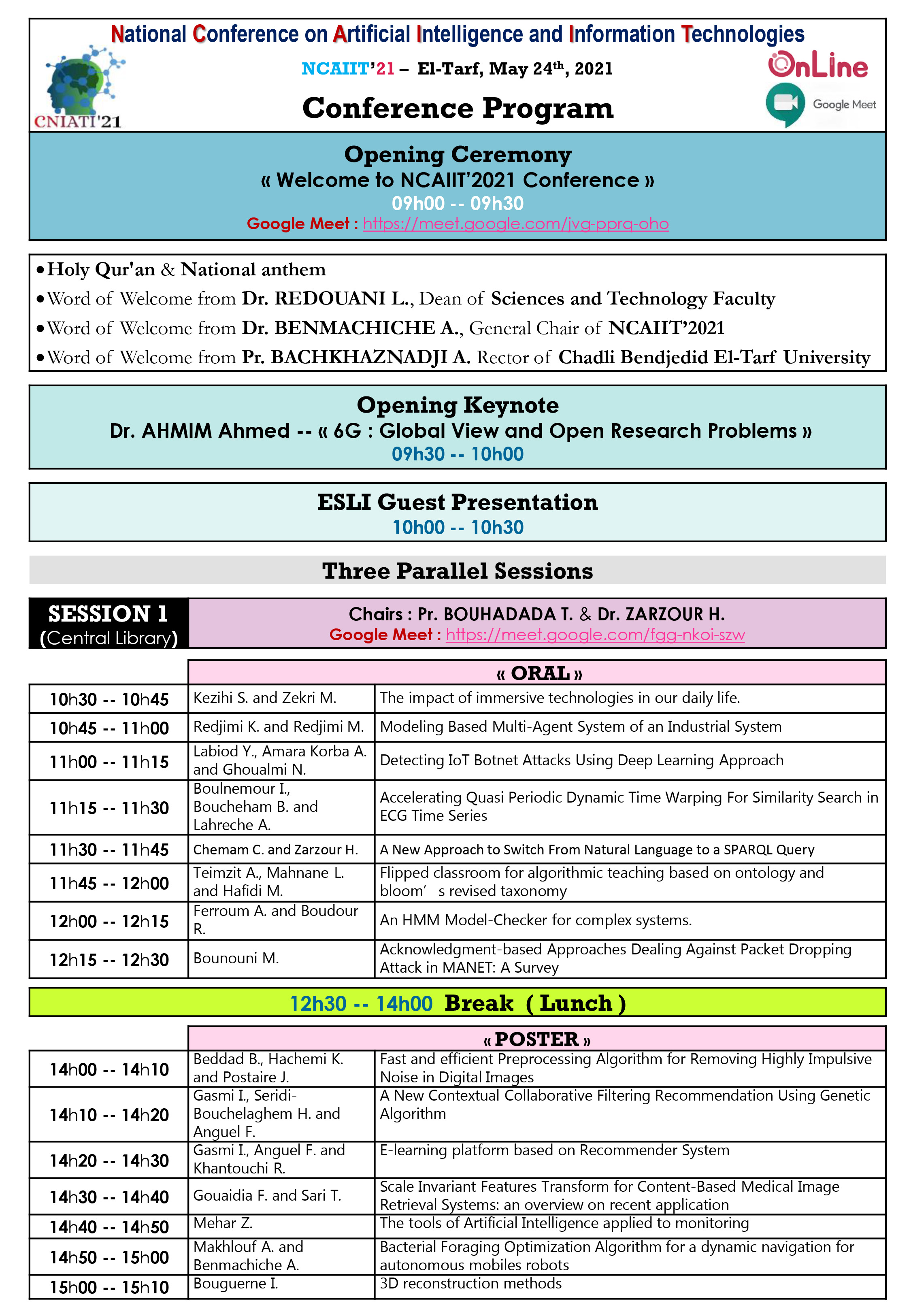
Teimzit Amira, Mahnane Lamia, Mohamed Hafidi. (2020), Flipped classroom for algorithmic teaching based on ontology and bloom’s revised taxonomy. First National Conference on Artificial Intelligence and Information Technologies (NCAIIT’20)http://univ-eltarf.dz/fac/fac_st/images/seminaire/2020-2021/NCAIIT_2021_ConferenceProgram-2.jpg
2019
Benmesbah Ouissem, Mahnane Lamia, Hafidi Mohamed. (2019), Ontology-Based Context Modeling for Adaptive Learning. 2nd Conference on Informatics and Applied Mathematics (IAM’2019)https://labstic.univ-guelma.dz/fr/content/2nd-conference-informatics-and-applied-mathematics-iam2019